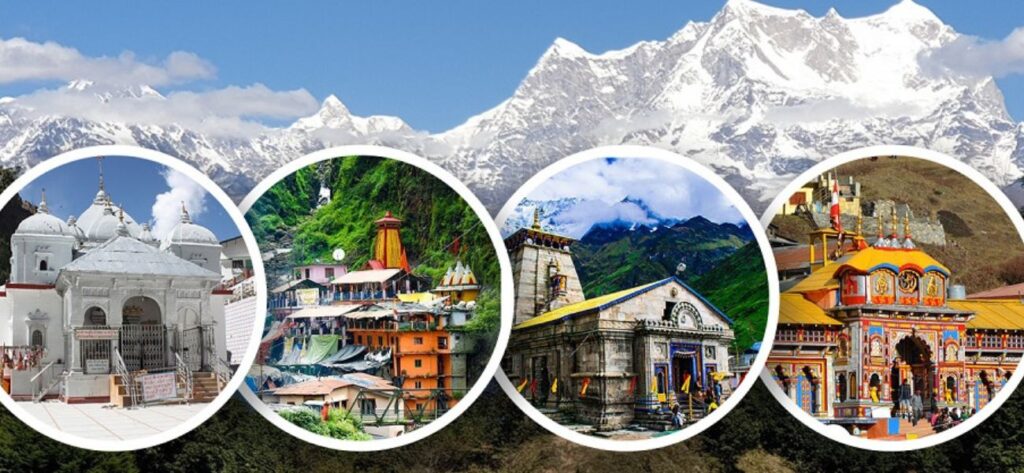
The Char Dham Yatra is one of the most important and sacred pilgrimage journeys for Hindus, involving the visit to four holy shrines located in the state of Uttarakhand, India. The term “Char Dham” literally means “four abodes”, and these four sacred sites are believed to help devotees attain moksha (liberation) and spiritual peace.
Yamunotri
The main attraction at Yamunotri is the Yamunotri Temple, dedicated to Goddess Yamuna, which was originally constructed by Maharaja Pratap Shah of Tehri Garhwal. According to Hindu mythology, bathing in the waters of the Yamuna is believed to cleanse sins and protect devotees from untimely death, as the Yamuna is considered the daughter of the Sun God (Surya) and the sister of Yama, the God of Death.
The actual source of the Yamuna River is the Champasar Glacier, located at a height of around 4,421 meters (14,505 feet) near the Kalind Mountain, but due to the difficult terrain, most pilgrims visit only the temple. Yamunotri is also the first stop in the famous Char Dham Yatra of Uttarakhand, making it a significant spiritual destination for devotees from across India. The temple opens every year around April/May and remains accessible till October/November, after which the region becomes covered in snow.
Gangotri
Gangotri is a sacred Hindu pilgrimage site located in the Uttarkashi district of Uttarakhand, India. It is famous as the origin of the holy River Ganga (Ganges), which is considered the most sacred river in India. Gangotri is situated at an altitude of approximately 3,100 meters (10,200 feet) in the Garhwal Himalayas and is surrounded by snow-covered peaks, dense forests, and breathtaking natural beauty.
The main attraction of Gangotri is the Gangotri Temple, dedicated to Goddess Ganga, which was originally built by the Gorkha General Amar Singh Thapa in the early 18th century. The actual source of the Ganga is the Gaumukh Glacier, located about 19 kilometers beyond the temple, but most devotees visit only the temple due to the challenging trek to Gaumukh.
Kedarnath
Kedarnath is one of the holiest Hindu pilgrimage sites, located in the Rudraprayag district of Uttarakhand, India. It is situated at an altitude of approximately 3,583 meters (11,755 feet) in the majestic Garhwal Himalayas, near the banks of the Mandakini River. Kedarnath is dedicated to Lord Shiva and is one of the twelve Jyotirlingas, which are considered highly sacred shrines of Lord Shiva across India.
The main attraction of Kedarnath is the ancient Kedarnath Temple, believed to have been originally built by the Pandavas and later renovated by Adi Shankaracharya in the 8th century. The temple is constructed from large stone slabs and stands as a remarkable example of ancient Himalayan architecture, surrounded by snow-clad peaks and breathtaking natural beauty.
Badrinath
Badrinath is one of the most sacred Hindu pilgrimage sites, located in the Chamoli district of Uttarakhand, India. It is part of both the Char Dham Yatra of Uttarakhand and the Char Dham of India, making it a highly significant spiritual destination. Badrinath is situated at an altitude of approximately 3,133 meters (10,279 feet) in the Garhwal Himalayas, along the banks of the holy Alaknanda River.
The main attraction of Badrinath is the famous Badrinath Temple, dedicated to Lord Vishnu, who is worshipped here in the form of Badri Narayan. The temple’s idol, made of black stone (Shaligram), is believed to be one of the eight self-manifested idols of Vishnu (Swayambhu). The present structure of the temple was established by the great saint and philosopher Adi Shankaracharya in the 8th century, although the site itself has been considered sacred for thousands of years.
